Affordable online MBA programs have changed the cost equation for working professionals. Elite residential programs regularly exceed $100,000 in tuition, with total two-year costs — including living expenses and lost income — reaching $200,000 or more at top schools. Online options cut that figure dramatically. Some accredited programs now cost under $10,000 in total tuition, letting you study while you work and graduate with minimal debt.
This article covers the cheapest accredited programs available, how to fund an MBA fully or nearly so, how age factors into your chances, and how to evaluate scholarship platforms before you spend time on them.
Program | Accreditation | Approx. Total Tuition |
|---|---|---|
University of Texas Permian Basin | AACSB | ~$10,000–$11,700 |
Rogers State University | ACBSP | ~$4,100/year |
Cal State Bakersfield | AACSB | ~$4,400 |
Florida Gulf Coast University | AACSB | ~$12,000 |
University of Central Arkansas | AACSB | ~$13,000 |
Verify tuition directly with each institution — rates change annually.
What Makes an Online MBA "Affordable"?
The sticker price on an MBA can mislead you. What matters is total program cost, not the per-credit rate on a brochure. A 36-credit program at $300 per credit costs $10,800. A 30-credit program at $500 costs $15,000. Always calculate the full outlay.
For online programs, out-of-state tuition is less of a problem than it used to be. Many schools now charge a flat national rate regardless of where you live. The University of Texas Permian Basin, for example, charges the same tuition to every student — in-state, out-of-state, and international.
Accreditation is the other variable that changes the value of a low-cost degree. Three bodies accredit U.S. business schools:
AACSB — held by roughly 6% of business schools globally; the strongest signal for employers and graduate programs
ACBSP — widely accepted, particularly at smaller regional schools
IACBE — valid but carries less weight at large employers, in consulting, and in finance
Regional accreditation is the minimum floor. AACSB accreditation is the target if career mobility matters to you. The good news: several of the cheapest programs in the country carry AACSB accreditation, so you do not have to trade quality for cost. Online students also qualify for the same federal financial aid as on-campus students under U.S. Department of Education rules — an important point when building your funding plan.
The Cheapest Accredited Online MBA Programs
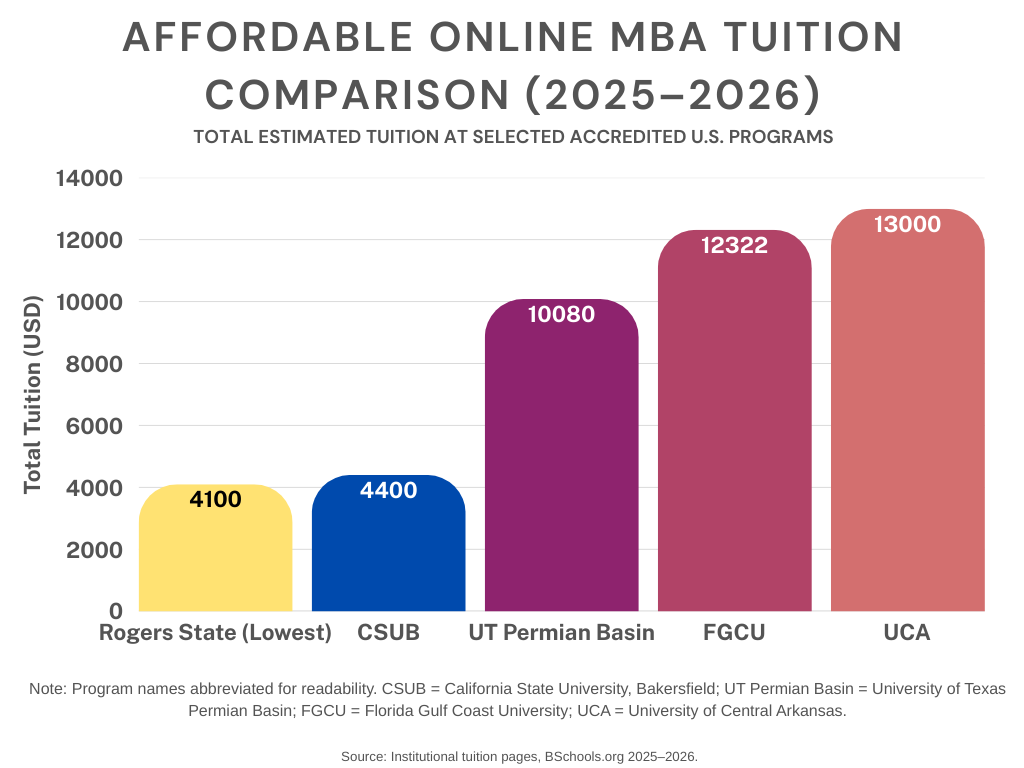
According to tuition data compiled by BSchools.org from over 288 universities for 2025–2026, the cheapest accredited online MBAs range from roughly $4,100 to $11,700 in total tuition. U.S. News data puts the average per-credit cost among the 20 most affordable programs at $322 for out-of-state students in 2025–2026.
University of Texas Permian Basin consistently ranks among the most affordable AACSB-accredited online MBAs in the country. Total tuition sits around $10,000–$11,700 depending on credit load, the program is 100% online, and students can finish in 12 months. The same PhD faculty who teach on campus teach the online sections.
Cal State Bakersfield offers one of the lowest total costs at approximately $4,400, carries AACSB accreditation, and holds a 94% student recommendation rate based on survey data compiled by OnlineU. That combination of low cost, accreditation, and student satisfaction makes it one of the stronger value options available.
Rogers State University comes in at around $4,100 per year — among the lowest annual tuitions on any accredited list — though its accreditation is through ACBSP rather than AACSB.
Florida Gulf Coast University is AACSB-accredited, completable in as little as 12 months, and costs just over $12,000 in total tuition. It ranks inside the top 200 online MBAs in the U.S. per BusinessBecause.
University of Central Arkansas offers an AACSB-accredited program for around $13,000 with concentrations in health care administration, information management, and finance.
One caveat: low tuition does not mean low total cost. Factor in fees, textbooks, and technology requirements. Some programs also charge additional fees for foundation courses if you do not have an undergraduate business background.
The return on investment case is straightforward regardless of which program you choose. GMAC reports that MBA graduates in 2025 earned a median starting salary of $125,000 — significantly higher than the average for bachelor's degree holders. At a $10,000 program cost, the payback period is short.
What Elon Musk Said About MBAs — and What It Actually Means for You
At the 2020 Wall Street Journal CEO Council Summit, Musk said there were too many MBAs running companies. He coined the phrase "MBA-ization of America" and argued that corporate leaders spend too much time on board meetings and financial presentations instead of building products. His position: leadership should come from working your way up, not from parachuting in from business school.
Business school leaders pushed back. Former Columbia Business School dean Glenn Hubbard argued that MBAs give leaders the foundation to develop products, build strategy, and assemble teams. Stanford management lecturer Robert Siegel called Musk's comments "completely off base" when applied to MBA programs broadly.
What does this debate mean for you practically? Musk's critique targets leadership culture at large corporations — specifically people who hold management roles without hands-on experience. It does not apply to the working professional who enrolls in an online program while continuing to do their job. You build work experience and academic credentials simultaneously. The "parachuting in" problem does not arise.
It is also worth noting that Musk's companies employ MBAs. His criticism is cultural, not a blanket rejection of the credential.
The harder question is ROI. At $200,000, a full-time MBA from an elite program requires a major salary jump to break even. At $10,000, the math is entirely different. The credential pays for itself quickly, which is a counter-argument Musk's critics rarely make clearly enough.
Is 30 Too Late to Get an MBA?
No. The average age of students entering online and part-time MBA programs is around 34, according to data from Seattle University's MBA program. Executive MBA programs average higher — Chicago Booth EMBA students enter at 38, MIT Sloan's EMBA class averages 41.
Full-time residential programs skew younger, with average entry ages of 28–29 at most top schools. But Columbia Business School's class entering in 2025 ranged from 22 to 40 years old — 30 is well within the normal range even there.
For online and part-time programs, 30 is near the median, not the upper end. These formats attract professionals who have been working for several years and want to advance without leaving their jobs. That is exactly who the programs are designed for.
If you are applying in your 30s, particularly to online programs, focus your application on career trajectory, leadership roles you have held, and a clear explanation of what you want to do post-MBA. Admissions committees expect more professional context from older applicants. Vague goals hurt applications from experienced candidates more than they hurt applications from 25-year-olds.
One practical note: the opportunity cost argument against an MBA in your 30s mostly applies to full-time residential programs where you leave work for two years. Online programs remove that barrier entirely. You keep earning while you study.
How to Get an MBA Fully Paid For
True 100% funding is achievable but rare, and most people who manage it combine more than one source. Here are the four main routes.
Employer Sponsorship
This is the most common fully-funded path for working adults. Many mid-to-large employers offer tuition reimbursement or direct sponsorship for employees pursuing MBAs, particularly in finance, consulting, technology, and healthcare management. The catch is that most require a return-of-service commitment — typically one to two years post-graduation. Negotiate the terms clearly before you enroll.
Need-Based Institutional Aid
At elite programs, need-based aid can be substantial. Harvard Business School awards need-based scholarships to roughly 50% of its students, with an average award of around $100,000 over two years per HBS financial aid data. Stanford GSB fellowships are also need-based, with approximately half the class receiving funding.
At affordable programs, institutional aid applied to an already-low tuition can reduce your out-of-pocket cost significantly. Contact the financial aid office at any program you are seriously considering — many have funds that are not widely advertised.
External Fellowships and Diversity Awards
Several well-funded programs can cover substantial costs:
The Consortium for Graduate Study in Management offers merit-based fellowships covering full tuition at participating schools. One application can reach multiple programs.
Forté Foundation fellowships support women at participating MBA programs.
Reaching Out MBA (ROMBA) Fellowship targets LGBTQ+ candidates.
QuestBridge Graduate Match provides full funding at Stanford, Haas, Booth, Wharton, and Yale — but is restricted to QuestBridge undergraduate alumni.
Knight-Hennessy Scholars at Stanford funds up to three years of graduate study, including the MBA. It is one of the most competitive awards in graduate education globally.
Federal Financial Aid and Veterans Benefits
U.S. citizens and permanent residents can complete the FAFSA for federal loans. Online students are eligible on the same terms as on-campus students. Veterans have additional options: GI Bill benefits, tuition assistance, and the Yellow Ribbon Program. NYU Stern, for example, contributed up to $33,100 per year under Yellow Ribbon in 2025–2026 per the school's published data, matched by the VA for a combined benefit of up to $66,200 per year.
Scholarships — Finding Money Others Miss
Is the Niche $50,000 Scholarship Real?
Yes. Niche is a legitimate U.S.-based college search platform that has awarded millions of dollars in scholarships. The $50,000 no-essay award is real — winners are selected by random drawing and notified directly by email. The platform communicates only by email; any text message or social media DM claiming you won is a scam.
The important caveat: because it is a lottery, not a merit competition, you should treat it as a two-minute low-effort entry, not a funding strategy. It is also open primarily to high school and undergraduate students planning to start college or graduate school within the next year. Confirm current eligibility terms on the Niche site before applying, as deadlines and eligibility windows change each cycle.
Can you trust Niche scholarships generally? Yes — Niche-sponsored scholarships are free to enter and pay real awards. Third-party scholarships listed on the platform vary; vet each one individually before investing application time.
How to Find Hidden Scholarships
Most students search national databases and compete with tens of thousands of applicants for the same money. A better approach is to go narrower.
Local and community-based scholarships — from civic groups like Rotary Club, local community foundations, and regional professional associations — often have applicant pools of 50 to a few hundred people. A $5,000 local award with 50 applicants gives you 25 times better odds than a $100,000 national award with 25,000 applicants, as SAGE Scholars research illustrates.
Practical steps:
Search with narrow queries: combine your city, field, and identity markers (e.g., "Chicago MBA scholarships finance women")
Search within community foundation websites directly using site: queries
Ask your program's financial aid office for institutional awards not listed on public databases — these often go undersubscribed
Check professional associations in your target industry; many offer scholarships that rarely appear on aggregator sites
Employer scholarship programs for employees or their dependents are another underused source
Avoid anything that charges a fee to apply or requires bank information. Real scholarships are always free to enter.
What Is the Hardest MBA Scholarship to Get?
The most competitive fully-funded awards in MBA education include:
Knight-Hennessy Scholars (Stanford) — up to 100 students selected annually across all Stanford graduate programs; requires exceptional leadership, academic achievement, and civic commitment
Oxford-Pershing Square Scholarship — five full awards covering both a Master's and MBA degree
Weidenfeld-Hoffmann Scholarship (Oxford) — full funding for students from developing and emerging economies; recipients are expected to return to their home country after graduation
For U.S.-based merit awards within MBA programs, Harvard's RISE Fellowship and Wharton's Joseph Wharton Fellowship are among the most selective. These are not realistic targets for most applicants — they are included here because they come up frequently in searches and are worth knowing about before you budget around them.
Key Considerations Before Choosing a Cheap Online MBA
A low tuition is a good starting point, not a complete decision. These factors matter just as much:
Accreditation level. AACSB is the target. If the program you are considering holds only regional accreditation or ACBSP, research how employers in your specific industry and region view it before enrolling.
Employer perception by industry. In most management roles at mid-market companies, the MBA credential matters more than the institution. In consulting, investment banking, and top-tier tech, school prestige still factors into hiring decisions. Know your market before you decide that a $4,000 program is the right call.
Concentrations available. Some low-cost programs offer limited tracks; others offer a wide range. If you need a specific concentration — health care administration, data analytics, cybersecurity management — confirm it is available before applying.
Time to completion. Many programs are completable in 12 months full-time or 24–36 months part-time. Faster completion reduces opportunity cost and gets you back to focusing on your career sooner.
Rolling admissions. Roughly half of top-ranked online MBA programs use rolling admissions per U.S. News data, which gives you more flexibility on start dates. If you want to start quickly, check whether your target program admits on a rolling basis.
Alumni network. Tuition price tells you nothing about the quality of the alumni network, which is often the most durable career benefit of an MBA. Ask programs directly about job placement rates and alumni activity in your target industry before committing.
 Health Care in the U.S. for International Students: Insurance, Costs, and Where to Get Care
 How International Students Can Build Successful U.S. Companies on F-1 and OPT Visas
 Are Extension Schools Worth It? Pros, Cons, and Costs
 Do College Career Development Programs Help Students Get Jobs?
 How Universities Can Improve Student Engagement and Retention